GreyCat is not a benchmark demo. It runs live, mission-critical workloads
today — from a national electricity-grid digital twin that tracks millions of assets and billions of
meter readings, to a unified AI-search platform that collapsed an eight-component RAG stack into a single
binary. Here is what that looks like in the real world.
Kopr — a national electricity-grid digital twin
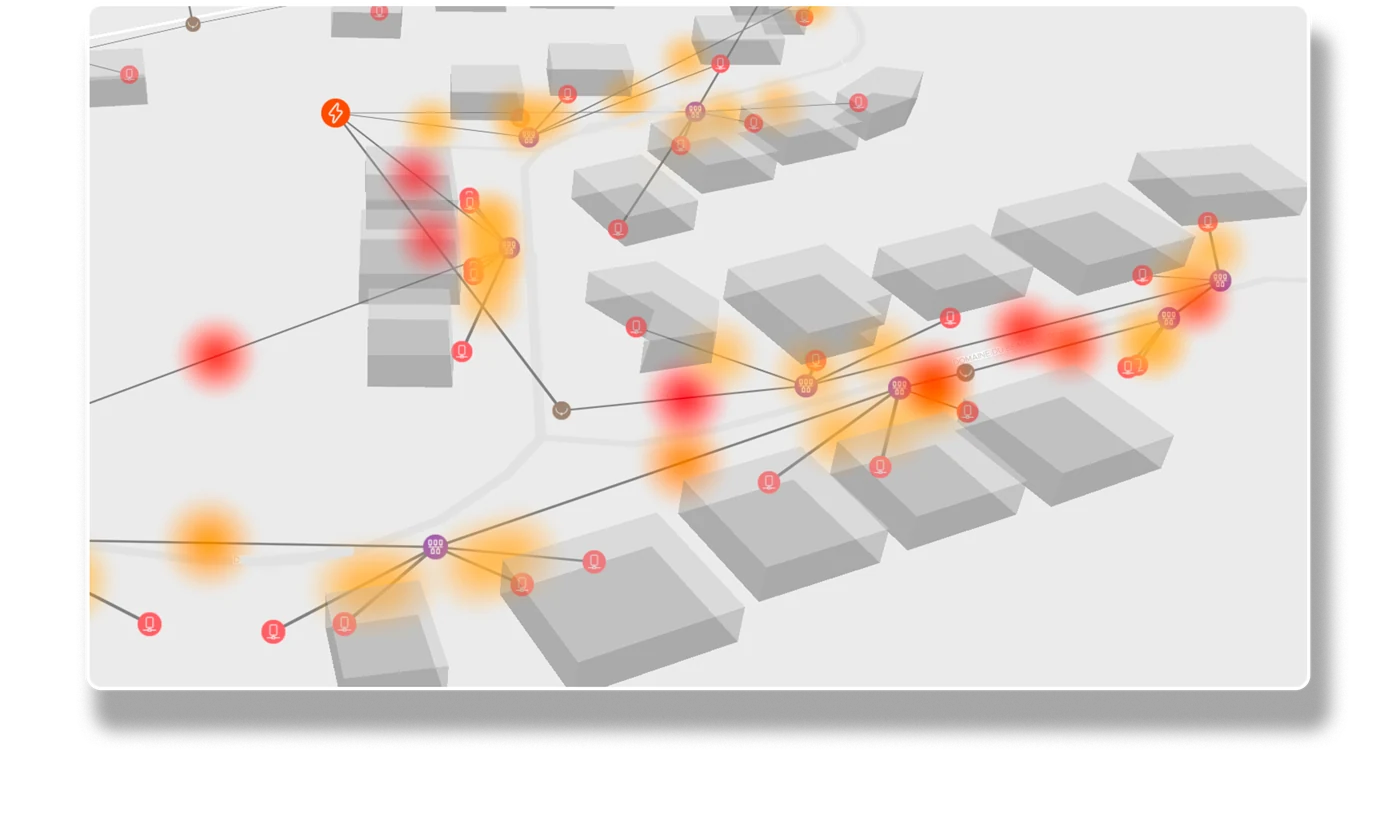
A full digital twin of an electricity distribution grid, built on GreyCat —
kopr-twin.com.
1,000,000
grid assets
330,000
delivery points
45 billion
meter readings / year
Kopr is a complete operational digital twin of an electricity distribution grid, built on top of
GreyCat. It mirrors the physical network — substations, transformers, lines and delivery points — as a
live, queryable model, and keeps that model continuously in sync with the data that flows from the field.
To do that, Kopr aggregates data that traditionally lives in silos: GIS network topology, the SAP asset
and work-order backbone, smart-metering data and real-time sensor feeds, all unified inside GreyCat's
temporal graph. Because graph, time-series and geospatial data share a single engine and a single
transaction, the twin can answer questions across all of them at once — what is connected to what, what
happened when, and where.
On top of that unified store, Kopr trains machine-learning models in near real-time over the live data
stream, turning the twin into an operational decision helper for grid operators rather than a static map.
The deployment scales to millions of grid elements and billions of measurement points — proof that a
single GreyCat instance can carry a country-scale industrial digital twin in production.
Unifying an 8-system RAG stack for a European enterprise legal-research platform
One binary replaced a typical eight-component RAG architecture for a European enterprise
legal-research platform.
66,388
documents
1,273,528
searchable paragraphs
9
search modes
62
REST endpoints
34
MCP tools
Legal research is unusually demanding for a search system. Practitioners need semantic search to find
concepts, exact-citation lookup to resolve references precisely, boolean queries for rigorous filtering,
fuzzy-name matching for parties and judges, and citation-network analysis to follow how rulings cite one
another. Historically that meant stitching together several databases plus an embedding service and an
orchestration layer — a fragile, expensive pipeline.
On GreyCat it became one binary. A single unified store holds the graph, time and vector data together;
one query endpoint exposes 9 search modes — hybrid, BM25, semantic, fuzzy, boolean, phrase, proximity,
prefix and did-you-mean — over the same index. 57 REST endpoints, governed by role-based access control,
serve the application, and a built-in MCP server exposes 39 tools so AI assistants can query the corpus
directly. The result is sub-second search across 1,273,528 searchable paragraphs, replacing a typical
eight-component RAG stack: a separate vector DB, graph DB, keyword index, embedding server, reranker,
orchestration layer, cache and UI.
Consolidating all of that onto GreyCat's text_search library did more than simplify
operations — it cut backend code by about 36%. Fewer moving parts, fewer integration seams, and one data
model to reason about, secure and scale.